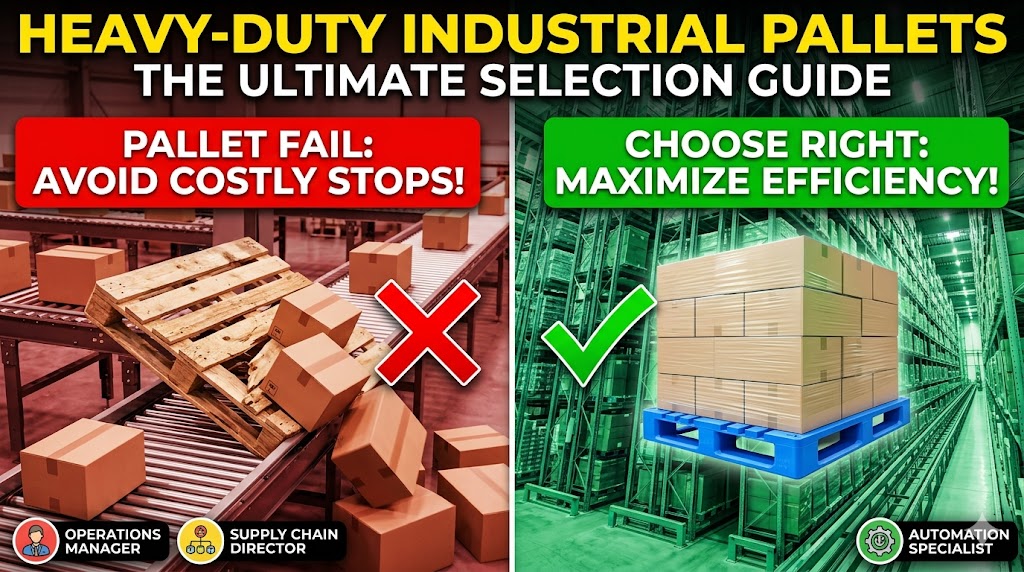

A complete procurement and engineering guide for operations managers, supply chain directors, and automation specialists.
In high-volume warehousing environments—where forklifts run around the clock and automated systems demand millimetre-level precision—the pallet is not just a commodity. It is mission-critical infrastructure. A single pallet failure can jam a conveyor line, crash an AS/RS shuttle, or create a safety hazard that shuts down an entire aisle for hours.
This guide is built for three types of decision-makers: the operations manager who needs pallets that survive brutal daily use, the procurement director who must justify capital expenditure with hard ROI data, and the automation engineer who requires exact dimensional tolerances and deflection ratings. If you fall into any of those categories, this is your definitive resource.
Why Pallet Selection Matters at Scale
A mid-sized distribution centre cycling 50,000 pallets per month will see each pallet handled an average of 4–8 times per journey. At that volume, even a 2% failure rate translates to 1,000 compromised loads per month—each one a potential safety incident, product loss event, or automation stoppage.
Key Statistic
The Grocery Manufacturers Association estimates that pallet-related damage accounts for over $2 billion annually in product loss across U.S. supply chains. In high-volume warehousing, the wrong pallet is not a minor inconvenience—it is a financial liability.
The three primary failure modes in heavy-duty environments are:
- Structural collapse under load — Boards split or deck planks crack when static loads exceed material limits, particularly with point-loading from heavy machinery or stacked SKUs.
- Dimensional inconsistency — Warped or out-of-spec pallets cause jams in conveyor systems and misfeeds in automated racking, leading to cascading downtime.
- Hygiene and contamination — In food, pharmaceutical, and chemical warehousing, porous wood pallets harbour bacteria, absorb spills, and fail FSMA and GMP audits.
Material Breakdown: What Each Pallet Is Made For
Not every material suits every operation. Below is an honest, unsparing comparison of the four primary heavy-duty pallet materials. Each has a clear best-use scenario—and clear limitations.
🌲 Hardwood Timber
Best for: Open-loop supply chains where pallets are expendable or pooled at low cost.
Hardwood pallets (oak, maple, beech) remain the industry default. A heavy-duty block pallet with 7+ deck boards can handle 2,500 kg+ dynamic loads. However, they degrade rapidly under repeated forklift impact—expect 15–30 trip cycles before significant structural compromise.
📦 HDPE Plastic
Best for: Closed-loop systems, food/pharma environments, and operations requiring hygiene compliance.
High-density polyethylene injection-moulded pallets offer exceptional dimensional consistency (±0.5mm) and are impervious to moisture, bacteria, and chemicals. Dynamic loads of 1,500–2,500 kg. Lifespan of 100+ trip cycles in controlled environments.
🧱 Structural Foam
Best for: Heavy static loads in racking systems where weight savings matter.
Structural foam pallets use a gas-injection moulding process that creates a dense outer skin with a lighter cellular core. This yields a superior strength-to-weight ratio. Racking loads up to 1,500 kg with minimal deflection. Ideal for deep-lane and push-back racking.
🛡️ Steel / Aluminium
Best for: Ultra-heavy loads (5,000 kg+), military logistics, and permanent captive fleets.
Metal pallets are the extreme end of the spectrum. Virtually indestructible with lifespans measured in decades. Dynamic loads of 2,500–5,000+ kg. Weight is the primary drawback—a steel pallet can weigh 30–40 kg vs. 20–25 kg for plastic.
Side-by-Side Comparison
| Specification | Hardwood | HDPE Plastic | Struct. Foam | Steel |
|---|---|---|---|---|
| Dynamic Load | 2,500 kg | 1,500–2,500 kg | 1,200–2,000 kg | 2,500–5,000 kg |
| Racking Load | 1,000 kg | 800–1,500 kg | 1,000–1,500 kg | 2,000+ kg |
| Dim. Tolerance | ±3–5mm | ±0.5mm | ±1mm | ±0.3mm |
| Avg. Trips | 15–30 | 100+ | 80–150 | 500+ |
| Cost Per Trip | $1.00–$3.00 | $0.80–$2.00 | $1.00–$2.00 | $0.30–$1.00 |
| AS/RS Compatible | ❌ Rarely | ✅ Yes | ✅ Yes | ✅ Yes |
Total Cost of Ownership & ROI Analysis
For procurement directors building a business case, the unit price is misleading. The only metric that matters is cost per trip—the total expenditure divided by the number of usable cycles before replacement.
ROI Scenario
Fleet of 10,000 pallets · 24-month evaluation period
Option A: Hardwood (replace 4×)
$1,200,000
10,000 × $30 avg × 4 replacements
Option B: HDPE Plastic (no replace)
$1,400,000
10,000 × $140 avg × 1 purchase
At 24 months, hardwood appears cheaper. But extend to 48 months (hardwood requires 8 replacements = $2.4M vs. plastic still on first fleet = $1.4M), and HDPE delivers 42% savings. Factor in reduced product damage claims and zero ISPM-15 treatment costs, and the gap widens further.
Hidden Costs of Cheap Pallets
- Product damage claims: Collapsed pallets can generate $10,000–$50,000 in insurance claims.
- Labour and downtime: Each failure requires 15–30 minutes of manual intervention to clear debris and restack.
- ISPM-15 compliance: International shipments on wood require heat treatment, adding $1.50–$3.00 per pallet.
- Conveyor damage: Splintered wood and protruding fasteners can tear belts and jam sortation systems.
Technical Specs & AS/RS Compatibility
If your warehouse uses or is planning to implement Automated Storage and Retrieval Systems (AS/RS), pallet selection is a systems engineering decision. The wrong pallet will crash a multi-million-dollar installation.
- Dimensional consistency (±1mm): AS/RS shuttles locate pallets by position sensors. Oversized pallets jam; undersized pallets slip. Wood cannot reliably meet this specification.
- Deflection under racking load (≤10mm): Crane forks must slide cleanly under the pallet on racking beams. Excessive deflection blocks extraction.
- Bottom deck profile: AS/RS conveyors rely on the bottom deck for chain or roller transport. An uneven profile causes jams.
- No protruding fasteners: Nails catch on conveyor chains and damage sensors. Plastic and metal are inherently fastener-free.
Recommendation for Automation Engineers
For any AS/RS installation, mandate HDPE or structural foam pallets from a single manufacturer to ensure batch consistency. Require a Certificate of Conformance (CoC) per batch with measured dimensional data. Build a 2% incoming inspection protocol to verify compliance before pallets enter the system.
Decision Framework: Matching Pallets to Your Operation
Scenario A
Open-loop supply chain, non-automated, budget-constrained
→ Heavy-duty hardwood block pallets. Accept the higher failure rate and build replacement costs into the budget.
Scenario B
Closed-loop system, food/pharma, hygiene-critical
→ HDPE injection-moulded plastic. Higher upfront cost is offset by zero contamination risk and 100+ trip lifespan.
Scenario C
Automated warehouse, AS/RS, precision racking
→ Structural foam or HDPE plastic (single-source). Mandate ±1mm tolerance and ≤10mm deflection.
Procurement Checklist
Before issuing an RFP or committing to a supplier, ensure every item below is addressed.
- ☐ Define load requirements: document dynamic, static, AND racking load needs per SKU category
- ☐ Specify dimensional tolerances required by your racking and conveyor systems
- ☐ Calculate Total Cost of Ownership over 36–60 months, not unit price alone
- ☐ Request ISO 8611 test certificates from every shortlisted supplier
- ☐ Evaluate hygiene requirements: FSMA, GMP, HACCP compliance if applicable
- ☐ Test a pilot batch of 100–500 pallets in live operations for 90 days before fleet commitment
- ☐ Verify supplier capacity to deliver your full fleet volume within required timeline
- ☐ Negotiate end-of-life terms: buy-back, recycling programme, or disposal responsibility
- ☐ Document pallet specifications in your warehouse management system (WMS) for ongoing compliance tracking
Ready to Optimise Your Pallet Strategy?
Get a custom pallet specification sheet tailored to your warehouse dimensions, load profiles, and automation requirements.
Request a Free ConsultationDisclaimer: Cost figures and load ratings cited in this article are representative industry ranges as of 2025 and will vary by supplier, region, and specification. Always verify ratings against ISO 8611 test data provided by your specific supplier. This guide does not constitute engineering advice for life-safety applications.